Infinite Heartbreak
Commitment of the Heart-Mind

Myth
Let me tell you a story. 1
There was once a young woman who lived in a distant kingdom, far removed from here and now in both time and space. She was born to a noble family and her father, let’s call him King Caecilius, was an ambitious man, with designs on both worldly power as well as power beyond death, he sought immortality. Caecilius was a tyrant, you see, who was driven to conquest and domination. His daughter, let’s call her Mirabella, was the youngest of three daughters. Her two sisters took after their father and were eager to be married off to powerful men so they could cement alliances. Mirabella wanted nothing of the kind. She was content to tend her garden, and paint landscapes, and to laugh and play with children of the servants who worked for her father.
On her 16th Birthday, Mirabella was ordered by her father to become the betrothed of a lesser nobleman’s son. There was nothing wrong with the boy, to speak of, other than his unreflective sense of duty and eagerness to take his own father’s place when the time came. He was ambitious but it was the ambition of his house, not his heart. Mirabella had no want of any of this. She refused to engage this man. She defied King Caecilius and insisted she be left in peace, else she would flee the palace forever. Her father became enraged and “called her bluff”, so to speak. He cast her out, disinherited her, and sent instructions to the neighboring counties that she should be given no refuge there or else there will be hell to pay.
So Mirabella left her father’s home and took up the life of a wanderer. She drifted from place to place for years, finding no refuge. In some places she was turned aside by the lingering fear of her father’s wrath. In other places she stayed for a while but did not find a home and moved on with her journey in a short time. She tried to stay at temples and shrines, but because she was an unmarried woman, the conservative priests and monks thought of her as indecent and shameful. They turned her away. She tried to stay in caves and hermitages, and found this a hard and unsatisfying life, it was lonely and isolated, and her heart yearned to connect with other people, so she wandered and wandered, from place to place, connecting with the small folk of the villages and countrysides.
During her wanderings she developed a reputation for her kindness and the intimate presence of her gaze. It was rumored that if she made eye contact with you and smiled at you, then any ailment you might be suffering from would surely be alleviated. This was true, actually, but as is often the case the reality is misunderstood and myth and story takes hold. Her gaze and smile could heal the sorrow and despair of anyone, but she had no more power to cure leprosy or cancer than any other human woman. Nonetheless, a story about the mysterious wandering healer spread. Across the counties and provinces of the land it was whispered that a living saint had emerged, with magical powers to cure any sickness. She was described as beautiful and with a noble bearing that seemed a mismatch for her torn robes and mendicant’s bowl. She dared not tell anyone her name, and wouldn’t say the reason why she couldn’t, so the people began to refer to her by the nickname “Loving Eyes”, after the quality of her gaze.
As King Caecilius approached the final years of his life, his health deteriorated, as is the way of aging, sickness, and eventually death. Caecilius had an absolute terror of death and a bitter resentment of his frailty. He had obsessed over immortality for his entire adult life and had not yet found it, despite spending great fortunes seeking it. In an act of desperation, he summoned before him a notorious demonologist, who promised that he had recently discovered the cure for any ailment. When Caecilius met with him he was told of the living saint who wandered from place to place. The demonologist had devised an elixir that could cure any sickness and would guarantee that anyone who takes the elixir will transcend the boundaries of life and death. The key ingredient in this elixir was the eyes and hands of a living saint.
So the old King agreed to do what the demonologist asked of him. He sent out his soldiers to scour the kingdom looking for the saint called Loving Eyes. They found her and took her into captivity. While she was detained, she asked the soldiers what this is all about. They explained that it was for the King, who needed medicine. They explained the requirements of the elixir and that she was to be maimed and dismembered in order to produce it.
When Mirabella arrived at the palace of King Caecilius, her childhood home, her father was shocked to see that Loving Eyes was none other than his own exiled daughter. She told him of her life and the way she had come to view her exile as the greatest gift anyone could have ever given her. She felt so much gratitude towards her father that she told him “I will repay the gift you have given me. I will offer up my eyes and hands to you, freely, with no hesitation or regret.” And so it was done. The demonologist took his terrible price and made the elixir for the King. Mirabella did not survive the procedure, though it was attested that she died with a smile on her face even as she bled out and succumbed to her wounds.
King Caecilius drank the elixir and promptly died. It was a swift and merciful death. Out of his corpse rose a Lotus Flower and out of the Lotus Flower, an apparition of Mirabella arose. The apparition had 11 heads, Mirabella’s own face, and then 10 more stacked on top of them as in a tower, facing in all directions. The apparition had 1000 pairs of arms and hands, and in the palm of each hand there was an eye. With her Loving Eyes, she gazed upon her father’s corpse, and wept from every one of her eyes. She continued to smile with all 11 of her faces. Then she vanished.
In the following weeks the Kingdom was blessed by cleansing rains that washed away the corruption that had gripped the land. The successor to King Caecilius was a moderate and temperate young Prince, the oldest son of Mirabella’s older sister, who had been raised in a neighboring county. He ruled justly until the end of his days. The people of the Kingdom erected shrines to commemorate Mirabella as Loving Eyes, and their shrines featured statues and paintings portraying the thousand-armed apparition that appeared on the day of her death. The demonologist was never heard from again, but it is rumored that whenever anyone makes a terrible oath he will reappear offering them an elixir.
Representation
I first encountered an image of 11-headed Kannon in a gallery in the Metropolitan Museum of Art in New York City. It had been donated to the museum from a private collector who had acquired a number of artifacts from the Shingon Buddhist tradition (Japanese Vajrayana). The statue is larger than life, about 12 feet tall including its pedestal. In the past it would have been painted, probably gold, though it is 800 years old and it was been worn down to bare wood once again.
On one fateful day in October, just before the full moon, I was standing in the gallery and something extraordinary happened. While standing in place and fixing my gaze upon the statue’s faces, my vision warped and roiled, and the shadows on the wall behind the statue seemed to awaken and began to move and multiply though the statue itself remained still. The shadow of the statue began to spring forth new pairs of arms and hands, two more, four more, eight more, sixteen more, doubling and doubling and doubling until there were too many arms to count. Thousands of arms.
The memory of the image has never left me. It burned itself into my memory with such vividness and detail that even now, a decade later, I can recall it as if it was yesterday. In my mind’s eye I conjure this image and I feel presence. The presence of the statue. The presence that the statue is a representation of.
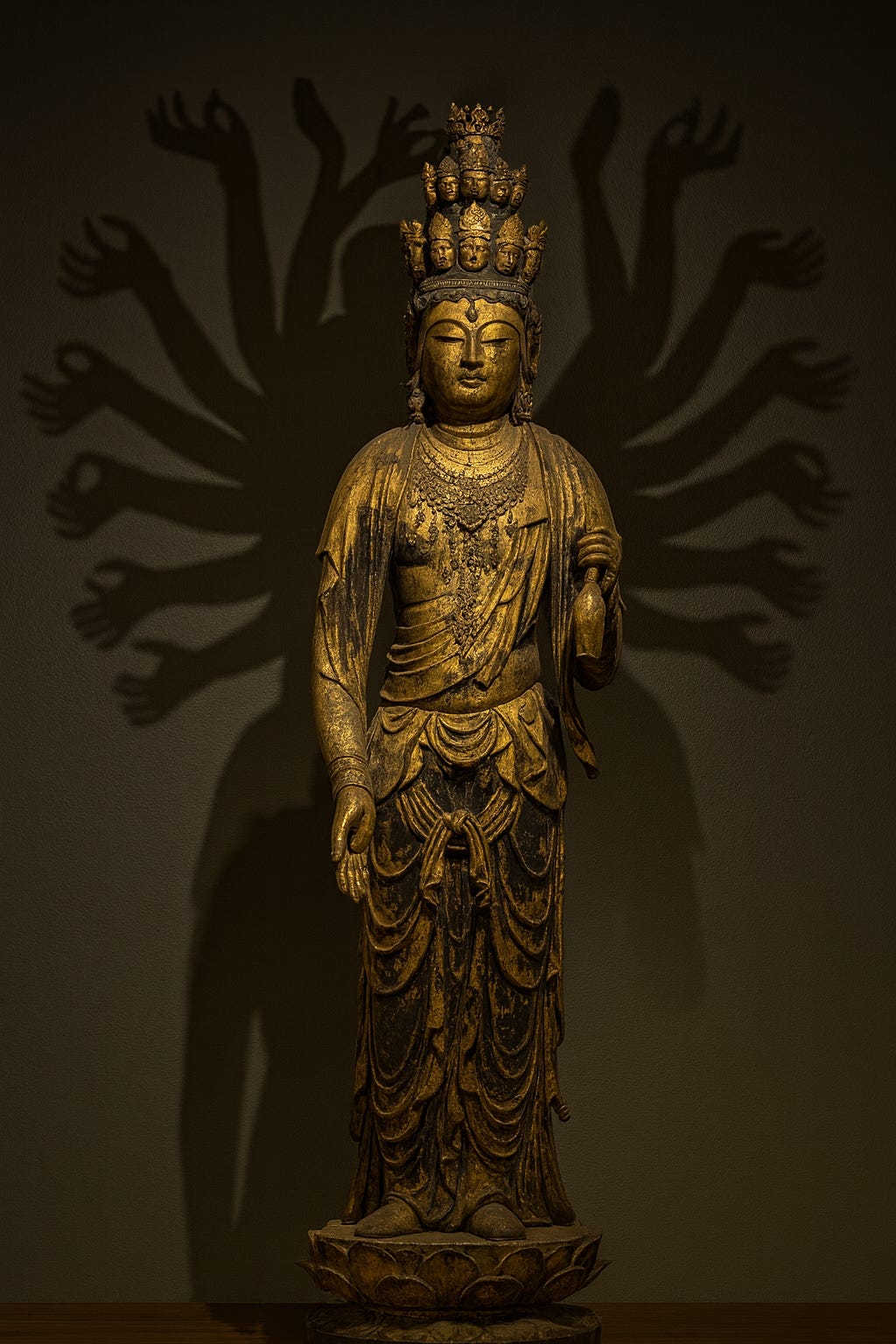
Let’s talk about the imaginal. There is a faculty of the mind to both produce as well as consume imagery. An image is a condensation of form into something highly concentrated. Potent. Unlike a sequence of words, which must be read through linearly, an image is multidimensional and far more dense in its ability to carry meaning. When an image carries meaning, when it becomes a metaphor, then it transmits that meaning like a firehose, in contrast to the slow trickle of meaning carried by word sequences.
The imagination is a portal. Its rends the veil between real and unreal and allows flow in both directions through that jagged gash. Yes, there’s a kind of violence in it. There is forcefulness and chaos in the imaginal. If an imagined thing is potent enough to become a metaphor, to carry meaning, then it is potent enough to shred the cloth that separates the images of the mind from the images of the eye. This is the difference between merely looking and truly seeing. Looking goes in one direction. Image enters mind and that’s it. Seeing goes in both directions. Image enters mind, reacts with the mind, and then becomes representation (lit: to show again) in subsequent vision. To truly see an image is to see it over and over again, not just the first time. To see it through memory. To see it through correspondence and analogy and similarity. To see it in the Mind’s Eye while looking at nothing at all. If it can be imagined then it is not merely sensation, it is resident in the substructure of the mind.
Shattering
There’s a subtle distinction in what is pointed at by the word “divinity” or “god” in traditional theistic religions and in Vajrayana. The distinction revolves around the ontology (“beingness” is a less academic word) of what it means to be a divine entity.
Most of us are already familiar with the traditional theistic notion. A god is a really extant entity that is, on some level, a person in their own right, though they may also represent (and wield) elemental forces of nature, or personify a slice of the spectrum of judgments we call morality (the source of all goodness, or the origin of all evil, or some mixture of these). The important part here is that a god is a distinct entity and you are not that entity. To make the claim that you are or even might be [a god] is generally blasphemous in these traditions.
Here’s a different notion. A divinity is a presence that is interactive and in some sense agentic, but is without independent existence, in a very specific sense. A personification of a god is not representational artwork or storytelling form as much as it is a handle, an instrument to make the entity more easily graspable by humans. There is not independent existence, but rather, there is interdependent origination of phenomena2. That’s a bit of jargon that can be unpacked to mean something like: the experience of something necessarily requires the mind of the experiencer, and there is nothing that can be experienced that is done so in the absence of a mind experiencing it. Suffice to say that divinities are viewed as experiences rather than distinct independent entities. Co-creations in/of/through the minds of humans.
There are some implications of this alternative view. Many of them are distinctions without a difference. A god is still a personified entity that can be revered, prayed to, invoked, etc. in the manner of the traditional theistic view. Here’s a distinction that matters a lot though: if the existence of the divinity is inextricably intertwined with the minds of humans experiencing/interacting with the divinity, then the claim that you are the divinity is not an outlandish and blasphemous claim. It’s a simple statement of phenomenological reality.
Let me tell you another story:
There once was a Mahadeva (that’s a Sanskrit word that means “big powerful divine person”) who did not answer to any specific name, but rather, was called according to their duty “The Fabulous Exalted Lord Who Watches Over All Sentient Beings”, or in the original Sanskrit Avalokiteshvara. They were given this name because of their activity. Watching over beings, with Loving Eyes, is what they do and therefore is who they are.
Well at some point the Lord Who Watches had awakened and in their awakening they expanded the scope of their activity beyond their capacity, for even a big powerful divine person is not truly infinite, and their duty of watching over all sentient beings is unbounded and limitless in scope. This was heartbreaking to them. They wept and despaired and begged to be granted the capacity to fulfill their duty in a truly infinite scope. Because the nature of this being is to bear witness, and the duty of this being is to hold what is witnessed with limitless compassion, they expanded into the awareness of all beings in all of time and space and in so doing they became utterly overwhelmed with the flood of sensation. Even a god can only withstand so much heartbreak before it takes its toll. Bearing witness to infinite heartbreak was more than the Watchful One could endure and so they shattered into ten thousand pieces.
Their prayers were answered by the Buddha of Infinite Luminosity, a being of genuinely cosmic (multiversal in fact) scope, who reconstituted the watchful lord into a new form. No longer limited by only their own two eyes and two (or is it four? or eight?) hands this new form has as many eyes and as many hands as is necessary to fulfill their duty: infinite eyes and hands. The representational artwork still reflects this today.
Will it shock you if I claim this is not an allegorical story, rather, it is instrumentally true, and is actually didactic rather than fanciful?
Begin with your own self. In your memory, witness the moments of your life that feel overwhelming, just absolutely shattering of your sense of self. The death of a loved one. The end of a meaningful relationship. The real felt pain and suffering of loss, those moments where it really hits you that nothing lasts forever and something you really wanted to last longer is through and will never be again. Who is witnessing it?
Now expand your awareness into a person nearby, whom you can see and hear. Can you empathize with them? Can you see on their face, and in the slouch of their shoulders, in the distractedness of their gaze, and the way they aren’t making eye contact, that they too have memories of moments that shattered them? Can you witness them in it? Who is witnessing it?
Now expand your awareness into the entire web of relationships with the world, with the other people in the world, and know that they too have their own moments of unbearable grief and heartbreak. Witness them in it. Who is witnessing it?
Now let the network of expanded awareness grow recursively in this manner without bounding conditions. Every being witnessing every being through the entire interrelated web of experiential awareness. Every node in the network is a pair of eyes and hands. That is who is witnessing it. You are already part of this network. How does it feel to increase your awareness of your membership in it?
I recall vividly a conversation with my teacher, years ago now, where we were discussing this topic. I had not fully understood the implications of all of this at the time and was trying as hard as I could to maintain the grip of intellect on it: to discuss it in symbols and words and meanings. She had very little to say to me about it. Her facial expression could not conceal some mixture of boredom and frustration at my rambling. She interrupted me at one point, somewhat abruptly, and simply asked me the question: “Have you felt your heart break infinitely?”
Relationship
What’s the difference between knowing about someone and really knowing someone? I don’t mean this as a philosophical question, just a practical one. If you really know someone then you recognize their face, their voice, the way their hold their body and how they move. If you know them especially well you might know how they like to dress, and whether they take their coffee black or with cream, and what their favorite band is. This is knowing in the sense of presence and interaction. Another word for that is relationship.
What kind of relationship is it possible to have with a god?
This is less of a question than it is a wrestling match. It’s a fraught subject to say the least. The answer to it that I spent most of my life with was “no relationship.” I was an atheist. Many come from the opposite polarization where the only available answer to it is “the relationship is worshipful and is prescribed by the church”. Well, there’s another possibility too though, which is that the relationship is an organic one, that grows from the soil of interactions between oneself and the divinity. This is the way humans relate to other humans, after all. Most human people have no relationship with most other human people, just because of circumstances, not due to an explicit rejection. But sometimes people meet and they develop a relationship with one another. They may become friends, or enemies, or lovers, or colleagues, or just passing strangers that never meet again.
Suppose you could meet a non-human person, in the field of awareness of the mind? What would that make available as relationship? What kind of relationship do you want to have? What kind of conditions would support that relationship?
Just as a stranger can become a friend through repeated encounters, a divinity can become a presence in your life through repeated encounter. At first they are just a name, a face, a story. But over time mutual recognition develops, and then the relationship begins.
Stepping In
In Chinese her name is 觀世音(Guan Shi Yin). The first character means perceive, the second character means entire world, and the third character means sound. This was how I came to know her. At some point (8th-10th centuries), when she crossed the Himalayas she transformed from the (androgenous male) Watchful Lord with Loving Eyes to the (unambiguously female) She Who Hears the Cries of the Entire World. There’s something about hearing, versus vision, it just seems to me to be so intimate. So penetrative. Where vision is something you look at, with a forward directed scanning gaze, hearing is something that comes to you, from all directions. Your vision is what’s in front of you. Your hearing is what’s all-around you and within you.
I learned how to listen for her, in the quiet emptiness of a calm mind. I learned to hear her voice, or voices I should say (she speaks in a chorus of thousands). I learned how to visualize her presence. With eyes closed. Then with eyes open. Then while walking around. I practiced communicating with her; I gave her my eyes and hands.
What kind of communication is possible with a being who is the integration of all perception, across time and space? My own sensations are her sensations. If my sensations are her sensations then my mind is her mind and her mind is my mind. This is not intersubjective communication, like a conversation. This is subjectless communication. Direct experience. The experience of giving one’s eyes, ears, voice, and hands to the goddess of mercy has the result of the goddess’ vision, hearing, speech, and action becoming your own. To see with her eyes is to see with the inherent intimacy and compassion that is the raw quality of awareness itself. There is no possibility of perception without intimacy. To witness another being is to love them, in the sense of an intimate embrace.
This is adapted from the legend of King Miaozhuang Wang which I have slightly changed to preserve the theme and symbolism while emphasizing the fable-like elements of the story and subtracting out the gratuitous bits of Confucian and Buddhist doctrine.
This is Pratītyasamutpāda or “doctrine of interdependent origination”