Radical Empiricism
A path of open minded observation


Roots
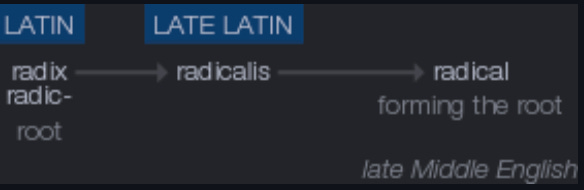
Etymology:
N-Gram (word frequency usage)
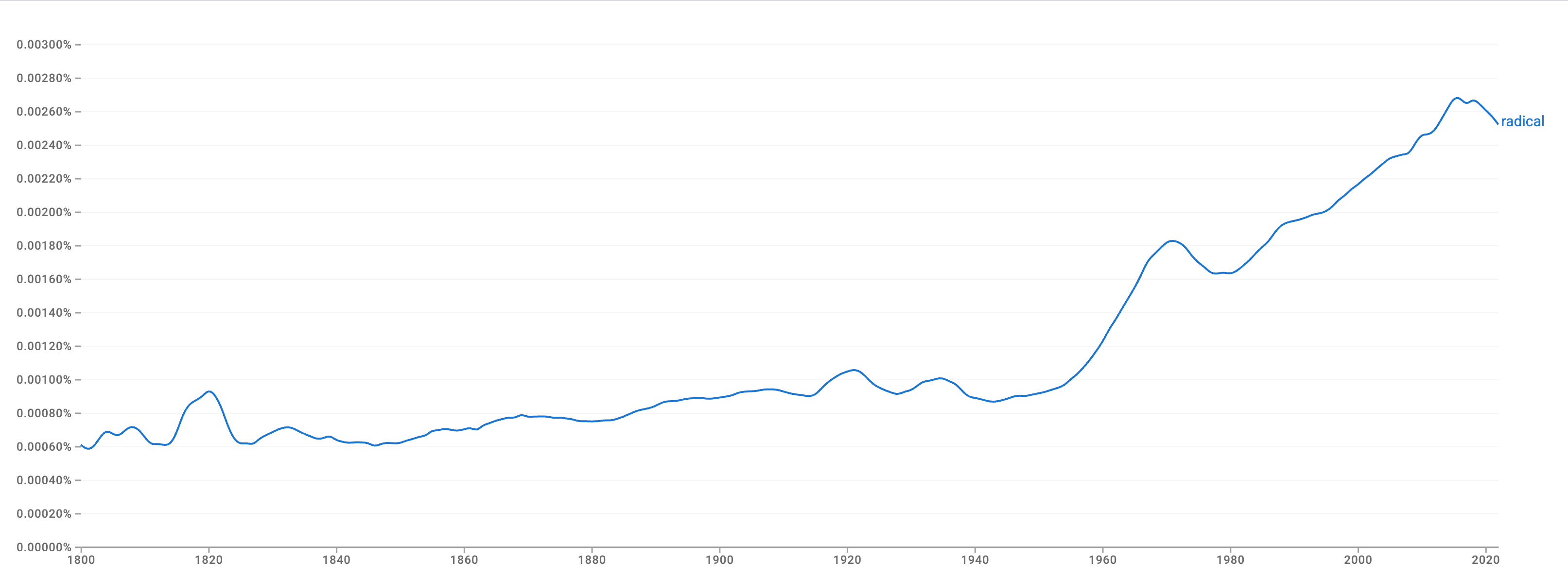
The word means “forming the root” though is often used with colloquial meaning that diverges significantly from that. It’s common for “radical” to be used with the meaning “really exceptionally good”. I think this slang usage first emerged in the 1950s sub-cultures (beatnik, jazz, etc.) and rapidly gained popularity through the 1960s (hippies, the successor sub-culture, with a much bigger demographic footprint), and then again in the 1980s (breaking into the mainstream) where it has remained a fixture ever since. The word has also taken on a different altered meaning, often associated with its usage as a political label as in “radical feminism” or “radical right-wingers” or similar, where it indicates extremism.
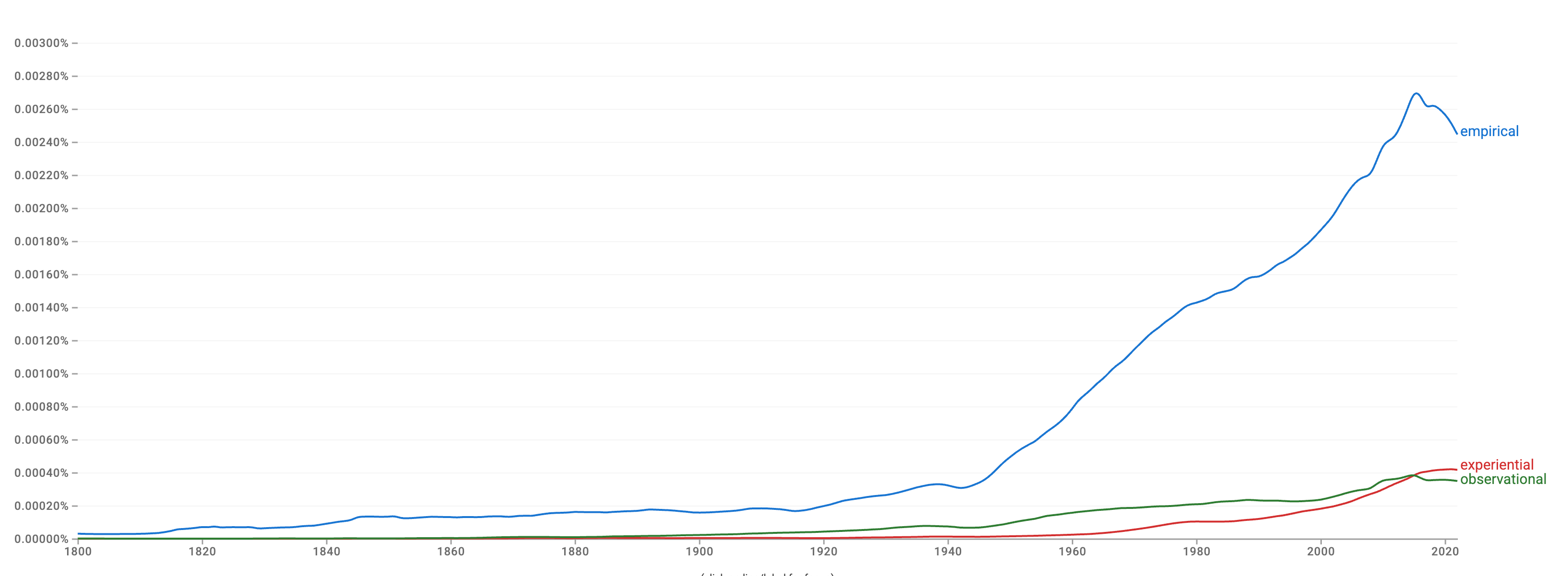
Empirical means experiential or observational. The word comes from Latin “empiricus”, which described a type of practicioner. One who derives their knowledge from experience. It often labeled medical practicioners who utilized practical knowledge and fieldwork to treat their patients, as opposed to doctors who based their work on ideas or theories (such as the theory of humors, or a theory of spiritual possession e.g. by a djinn or daemon). It was an archaic term for hundreds of years until it resurfaced as a term of discourse in academic writing in the 20th century.
Radical Empiricism, then, is a variety of practice that is deeply rooted in direct experience and observation, with a de-emphasis on theories or ideas. Radical Empiricism is the basis of the Modern understanding of science, which is a method of investigating knowledge-claims with the use of experiment and observation. This approach utterly transformed our societies’ understanding of the world and overturned millennia of approaches based primarily on reasoning from ideas and articles of faith. The example par excellence is the shift from the ancient Geocentric cosmos to the Modern understanding of the Heliocentric solar system as just one star system in a galaxy of billions of stars, in a cosmos of billions of galaxies. This shift was instigated by the discovery from observation that previous cosmologies did not match the observed reality.
Radical Empiricism is first and foremost a way of relating to knowing. The simplest form of it “seeing is believing”. The way we relate to knowing is the way we relate to the world. To know the world is to have a model of the world in your mind. What does it mean to know your mind? In my view, this is simultaneously the basis of both psychology and spirituality, which are two sides of the same coin. These are practice paths that describe methods to come to know about the mind.
How, then, does one become an Empiricus of the mind?
Shoots
The first questions we need to ask and answer are: “what instruments do we have to observe the mind?” and “which minds can we observe (and under what circumstances)?” The best instrument we have to observe the mind is the mind. The only mind we can directly observe is our own mind, using our own mind as the instrument by which we observe it. This really gets to the core of the problem of subjectivity.
But wait, you might be thinking, can’t we use fMRI imaging or something else more external and objective to observe the mind? No, not really. We can use instruments like these to observe specific features and activity of the body. We can look at blood flows or patterns of electrical conductivity within the brain, or we can look at heart rate and breathing rhythm, or other secondary indicators of mental activity. All of these methods can produce interesting and valuable data about the connection between the mind and body, but none of them can directly observe the mind. They are only observing the mind indirectly by observing the consequences of mental activity on the body. This is an illusory dualism, the activity of the mind is the activity of the body and vise versa, but the body is more readily observable and we do not have an external instrument with which to observe the interiority of the mind.
We need to use the mind to observe the mind because it is the faculty of awareness and recursion and reflection that the mind possesses that enables introspection into the actual activity of the mind in a direct sense. The contents of consciousness, as well as the embodied feelings of conscious awareness, are the primary subjects of our inquiry. Because we only possess these faculties with respect to our own mind, the only mind which we can directly observe is our own.
There are a great many different ecosystems of practices that can be used to train the mind as instrument. The world’s cultures have spent thousands of years producing and refining these methods, which are generally referred to using words like “contemplation”, “meditation”, “yoga”, or perhaps even “spirituality” or “psychoanalysis”.
I’ll briefly describe my favorite of these methods, which is a style of meditation derived from the Dzogchen tradition of Tibetan Buddhism. In the Tibetan language it’s called “shi-ne” which has the same meaning as “shamatha” in Sanskrit, both of these terms are usually translated into English as “calm abiding”. I prefer to label this practice as Opening Awareness though. It points at the method rather than result of the method. By Opening your Awareness, you are likely to discover that you are abiding in a state of calm spacious clarity. The pith instruction for Opening Awareness is something like “while sitting in silence, observe the space of the mind, while remaining uninvolved with whatever thoughts, sensations, and phenomena arise.” The instruction is simple but the practice is not easy.
Rather than focus on this practice, or any other specific practice, I’d like to focus on the view necessary to utilize the practice effectively. Contemplative methods are introspective and subjective. An important consequence of this is that the mind we are observing with contemplation is not a blank slate or absent of conditioning and habits of thought. The first thing we generally see when we look is the surface level manifestations of these habits and conditionings. We may see a lot of our own fantasizing, or we may experience a very insistent narrator telling a story about what’s happening in the mind. We may feel in our bodies the texture and quality of emotions, especially those related to memories or related to the recent events of our mundane lives. There’s a drive to interpret those sensations, whether they’re internal stories or somatic feedback, in a way that brings them into interpretive coherence. This is one of our most deeply entrenched habits. It can be very challenging to drop it.
Interpretive coherence is a habit rooted in discomfort with not-knowing. In the same way that it is difficult not to scratch an itch, it is difficult to not know what a mental experience means. The failure mode is insisting that we do know and forcing a specific interpretation onto the observed phenomena of the mind because it aligns and coheres with a set of prior beliefs. These beliefs may be about: who we think we are, or how we think we ought to feel about something, or how a particular set of assumptions (often metaphysical ones) are either confirmed or disproven by the phenomena. The necessary view for Radical Empiricism is to detach from forced interpretation, to relax the clench of desire to know what’s happening and what it means, and to attend only to what is observable during the act of contemplative practice. In other words, Radical Empiricism begins from doubt.
Doubt, here, should not be taken to mean personal insecurity or reflexive skepticism. Instead, we might view doubt as a form of sacredness. Doubt is the recognition that we have questions to which we do not know the answers. Doubt is the fertile soil from which curiosity, exploration, and discovery spring forth. In order to begin to know something we must first acknowledge that we don’t know it; this is sacred doubt. I like the word WONDER to encapsulate this view of sacred doubt. The view of Radical Empiricism is both wondrous and wonderful.
Buds
I want to say something about radical empiricism in religious life. The vast majority of established religions (including also ideologies that fit into the “religion” slot, e.g. Marxism, Materialism, Nationalism, etc.) are premised on a rigid metaphysics and many of them explicitly require public profession of Faith in these metaphysics as a requisite of group membership.
There are many reasons why things are like this, and that would be interesting to explore in long-form, but I’ll elide it today.
I’d like to promote Radical Empiricism as an alternative stance to Faith in a specific metaphysics as the basis for spirituality and religion. It’s so simple that it’s often totally unnamed and implicit because it can seem subliminal.
Radical Empiricism is the stance that we bring NO EXPLICIT PRIORS and draw NO UNIVERSAL CONCLUSIONS about our experiences in the spiritual domain. The only thing we bring to it is spacious clarity and an attitude of playful and courageous curiosity. We allow and admit all phenomena, whatever they are, without judgment (pre or post). We direct our examinations of these experiences towards their texture and flavor. We take description seriously but discard prescription entirely.
This is not a nihilistic rejection of assigning meaning to phenomena. Quite the opposite. This is the admission that any particular phenomenon might mean all kinds of different things depending on the circumstances (the who/what/when/where of it). We’ll leave the why unanswered. We’ll document the how in practical and actionable terms, for purposes of replication and verification. No rigid attachment to the how question. Only practical advice, so others can try it for themselves, and adapt it to their needs and circumstances.
The polysemous nature of inner phenomena is the base truth of it. We don’t need anything to mean just one thing. We benefit most from exploring phenomena with wonder and joy (and also sometimes terror and rage, if those are appropriate). Spacious clarity is the stance of allowing whatever will arise to arise without the need to control it. Only to see it clearly without becoming attached to it. All experiences arise and pass in their own time, mostly very rapidly.
We ought not to go chasing after certain types of experiences, like an addict chasing a high. We ought not to ban ourselves from having certain experiences, because we don’t like how they might feel or what they might mean. Just have the experience. Feel it. Don’t get fixated on what it might mean. Select your engagement with the possible meanings based on your situational needs and capacities. And be patient. Not all meanings are revealed right away. They can take a long time to show themselves in a way that’s tractable. Comfort in the not-knowing is a requisite here. It’s a practice in it’s own right.
But while we shouldn’t chase dragons, we should approach this in an organized and rigorous way, so that we can keep testing our results. This is a practice path and it does require discipline. Random grasping won’t do. We want to take an engineer’s approach to this. Control the circumstances, practice the method with rigor and discipline, and observe the results with spacious clarity.
Blossoms
Radical Empiricism is a view that permits curious free-wheeling exploration of the mind from the stance of viewing the world as a sacred mystery. I don’t mean to distract with mystifying language here. An alternative phrasing might be “the stance of viewing the world as garden”. We never did leave the garden.
When adopting this stance we are likely to experience a rapid transformation of our felt sense of self. The most extraordinary result I have experienced by application of radical empiricism as self-inquiry is that I am simply not who I imagined myself to be. I cannot find a single unchanging, essential self no matter how hard I look. What I find instead is an engine that generates selves. Any particular self arises, experiences the world, performs actions, and then eventually recedes, to be replaced by the next self to arise. It’s a continuous process of selfing, analogous to the continuous process of digesting food, or the continuous process of growing hair and fingernails.
The self that arises in any particular moment is certainly strongly influenced by history and circumstances, it is just as yoked to habits and conditioning as any other behavior, but it is only a behavioral pattern of interaction. This observation is in opposition to the many presentations of an eternal essential self that are the bread-and-butter of most metaphysics in the world’s religions and ideologies. When I examine the claim empirically I find that, in my own mind, it seems to be without basis. The method is radically empirical. It can be tested to see if it replicates. I encourage you to test it for yourself.
I recommend this approach because it’s liberating. No phenomena is itself a source of guilt, or shame, or any other negative judgment. Those feelings are downstream of the imposition of metaphysical interpretations and systems of morality based on zealous belief in the metaphysics. The usual result of this attachment to interpretation is the proliferation of human suffering. We don’t need to relate to it like that at all. The universe is a vast place full of mystery and wonder. The greatest joy I have ever known is in embracing the mystery, and finding in it that I am an explorer and that I am madly in love with all of existence. Every last drop of it is a cascade of fractal miracles through and through. All you need to do is witness it and remain open to the wonder.
A 💯 agree with the radical empericism concept! Thanks for elucidating a rational basis for this mental model and an active approach towards living an 'honest life' at that! This is the closest path in life one can take to live a fulfilling rich life too imo.
Growing up in India I was surrounded by metaphysical/magical ideas derived from religious dogma shouted from the loudest speakers to the Godmen who promised 'mahasamadhi' after death. It's applying magical thinking as a soothing balm to deal with the rawness of life, until one realizes the rawness can be contended with effectively if one practiced a life of radical empericism - the outcomes seem better in general - funny how that works huh!? Cheers.